What is the Mid Michigan College Headlee Override / Charter Millage Proposal?
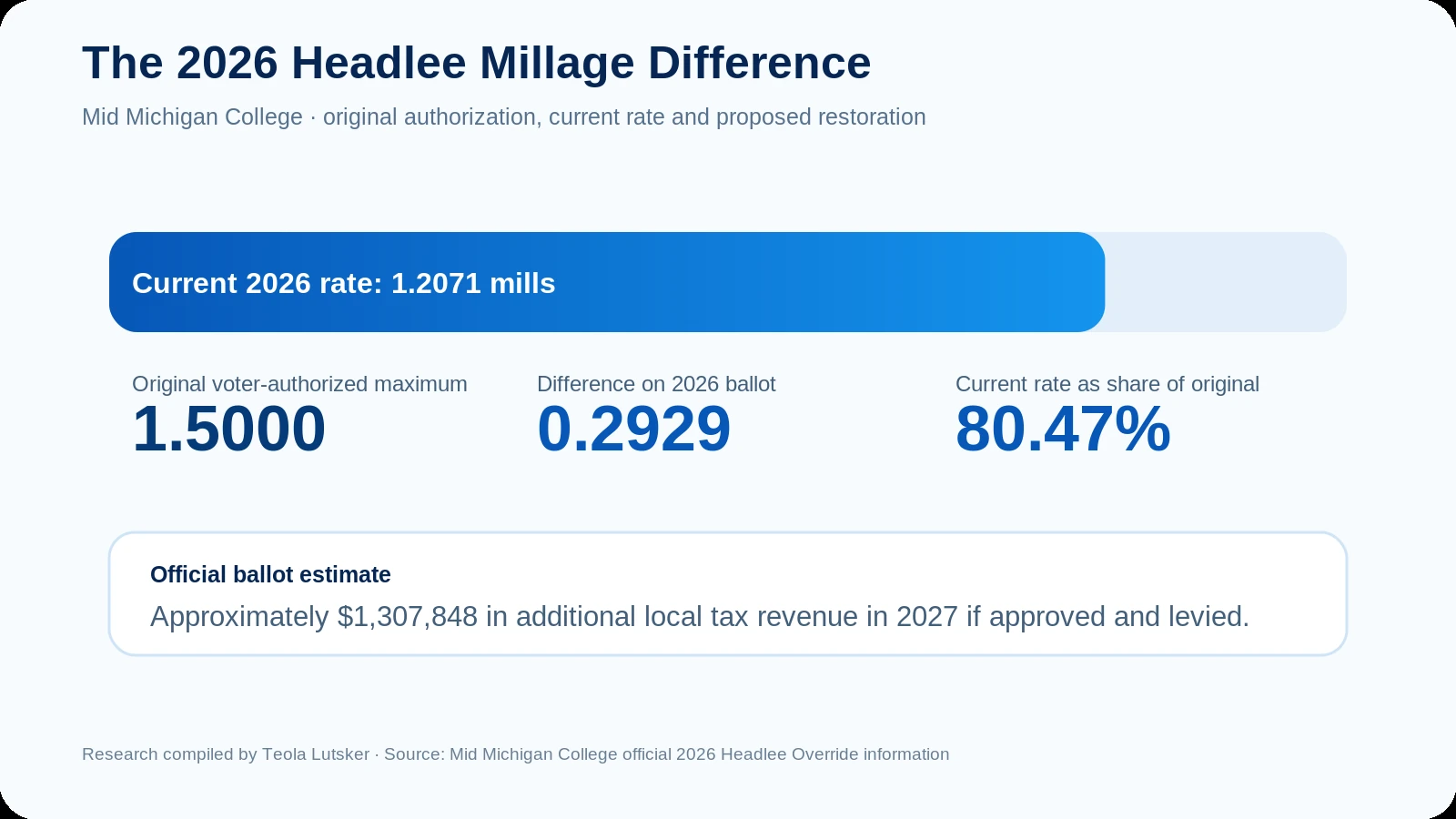
Mid Michigan College's official 2026 information says its operating millage has been reduced to 1.2071 mills. The November proposal asks voters whether to restore the maximum rate to the original 1.5 mills, a difference of 0.2929 mill.
The official ballot heading is “CHARTER MILLAGE PROPOSAL.” The ballot language says the increase would be perpetual and estimates approximately $1,307,848 in additional local tax revenue in 2027 if the proposal is approved and the additional millage is levied.
One proposal, two names
Residents may encounter two names for the same November 2026 Mid Michigan College ballot question. “Headlee Override” is the descriptive name Mid Michigan College uses on its informational materials. “Charter Millage Proposal” is the official heading printed with the ballot language. On this page, both terms refer to the same 2026 proposal to restore 0.2929 mill to the College's original 1.5 mill authorization.
This distinction matters because residents researching the proposal may encounter either term, even though both refer to the same November 2026 ballot question.
Read Mid Michigan College's official 2026 Headlee information and ballot language ↗
The 1.5 mills began with the College itself
Mid Michigan College's official history says a special election was held in September 1965 to authorize establishment of the College, elect a governing Board of Trustees, and approve a 1.5 mill construction and operating millage. The favorable vote led to official approval of Michigan's 25th community college.
This historical point matters because the 1.5 mills referenced in 2026 is the original voter authorized rate, not a newly selected ceiling.
Mid Michigan College Policy 104: History and Organization ↗
How Headlee changed the operating rate
Michigan's Headlee Amendment limits growth in property tax revenue from existing property. When the applicable tax base grows faster than the inflation based limit, a millage reduction fraction can reduce the maximum rate that may be levied. A voter approved authorization can therefore remain 1.5 mills while the rate available for levy becomes lower.
Mid's official 2026 page describes the current rate as 1.2071 mills. Restoring the rate to 1.5 mills would add 0.2929 mill. Mathematically, the current rate is about 80.47% of the original 1.5 mill authorization, a difference of about 19.53%.
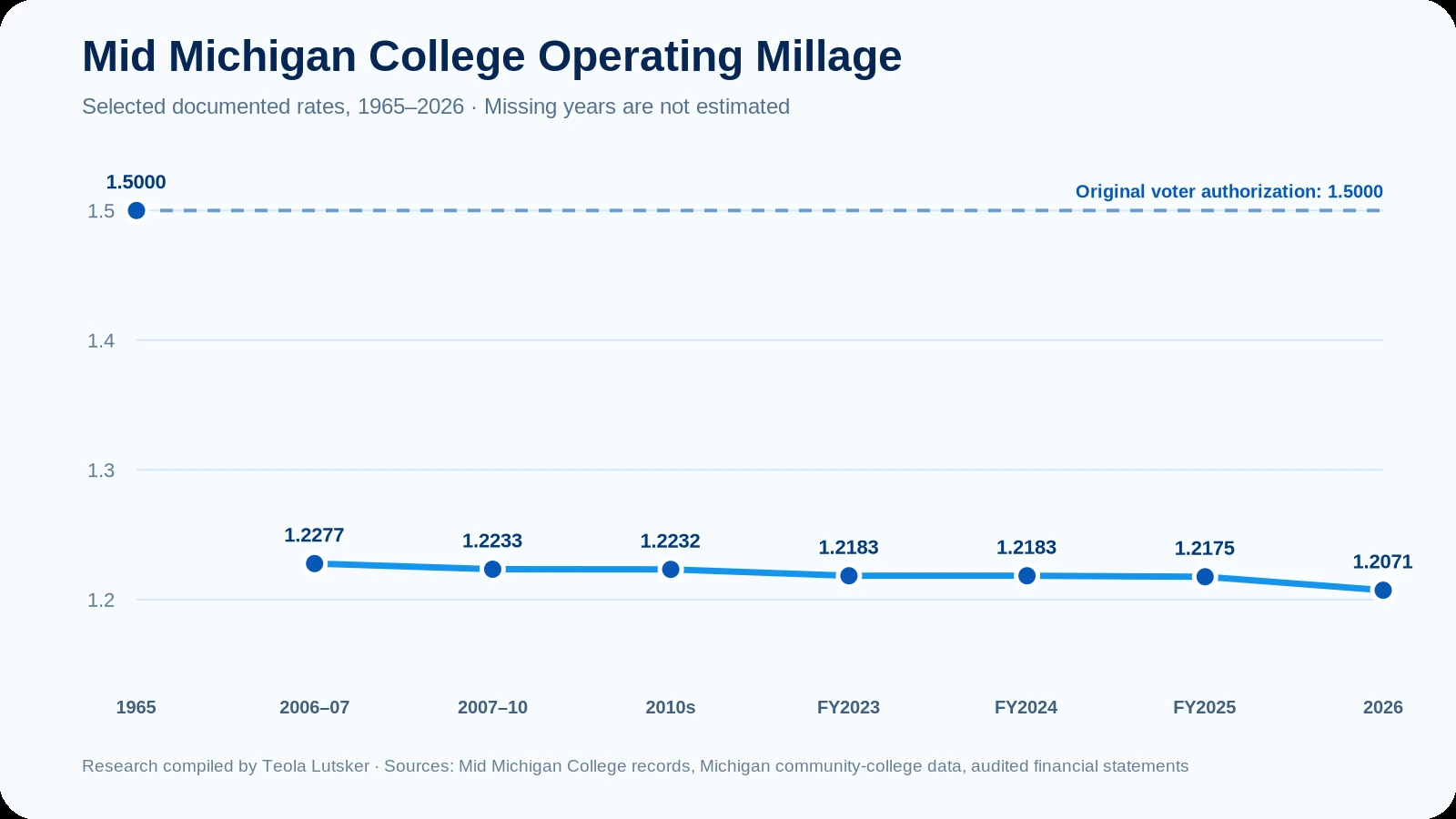
Documented Mid Michigan College millage history
The historical records do not provide one perfectly uniform annual series. Older state community college reports, Board levy resolutions, tax year disclosures and fiscal year audits use different reporting periods. For that reason, this research does not interpolate missing years or present unlike reporting periods as if they were identical.
| Period | Documented rate | Context |
|---|---|---|
| 1965 | 1.5000 | Original construction and operating authorization |
| 2006 to 2007 | 1.2277 | Historical community college reporting |
| 2007 to 2010 | 1.2233 | Historical community college reporting |
| 2010s | ≈1.2232 | Documented repeatedly in state/College records |
| FY2023 | 1.2183 | Audited fiscal year reporting |
| FY2024 | 1.2183 | Audited fiscal year reporting |
| FY2025 | 1.2175 | Audited fiscal year reporting |
| 2026 | 1.2071 | Current rate reported by Mid |
| 2026 ballot maximum | 1.5000 | If approved; future Headlee calculations may apply |
Note: This table intentionally identifies the reporting basis rather than creating a continuous annual line where source periods differ. Exact annual values should be interpreted within the source document's tax year, fiscal year or reporting year context.
A separate millage question appeared in 2020
In March 2020, voters considered a separate proposal for an additional 0.6268 mill. Contemporary election reporting recorded that the proposal did not pass, with 53.1% voting no. The 2026 question is different: it asks whether to restore the Headlee reduced charter millage by 0.2929 mill to the original 1.5 mill maximum.
Review the March 2020 election report ↗
The 2021 Mt. Pleasant annexation changed the tax base
Mid's official history says residents of the Mt. Pleasant Public Schools district voted in May 2021 to join the College's in district service area. Mt. Pleasant joined Beaverton, Clare, Farwell, Gladwin and Harrison in the College district.
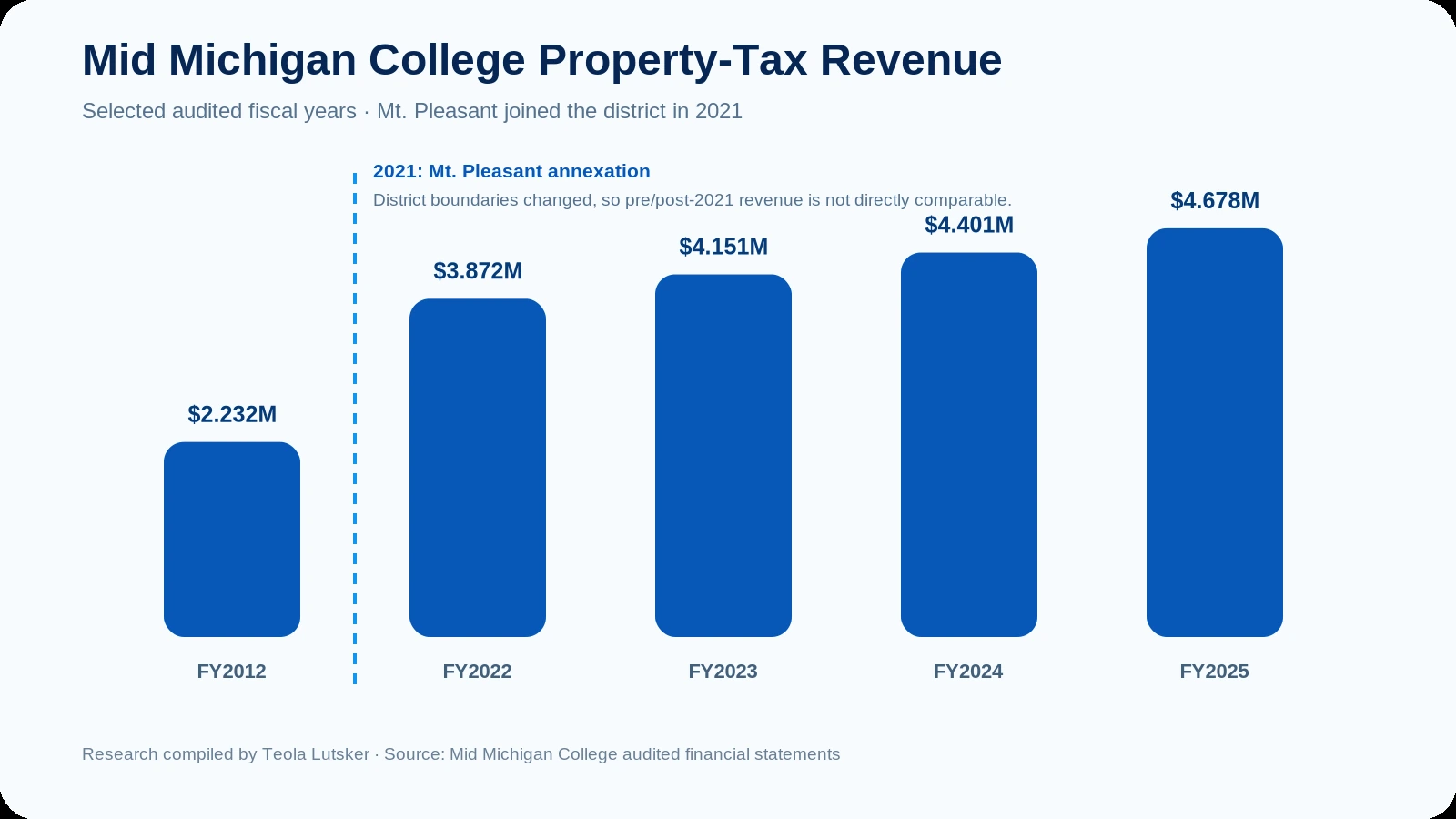
This is critical context for historical tax revenue comparisons. Adding territory to the district changed the amount of taxable property supporting the College. A revenue increase after 2021 therefore cannot be interpreted as the result of the millage rate alone.
Review Mid's official history of the 2021 annexation ↗
Property tax revenue increased while the rate declined
Mid's audited financial statements show why the millage rate and total tax revenue need to be examined separately. The College reported $3.872 million in property tax revenue for FY2022, $4.151 million for FY2023, $4.401 million for FY2024, and $4.678 million for FY2025. Earlier audited comparisons show approximately $2.232 million for FY2012.
Those figures increased even as the operating millage rate was below the original 1.5 mills. The 2021 district expansion is a major part of the context, along with changes in taxable values. A lower rate does not automatically produce lower total revenue if the taxable base is larger.
What does 0.2929 mill mean for a property owner?
Millages are calculated from taxable value, not simply a property's market value. One mill equals $1 of tax for each $1,000 of taxable value. The proposal's additional 0.2929 mill therefore represents $0.2929 for each $1,000 of taxable value.
| Example market value | Approx. taxable value | Direct calculation at 0.2929 mill | Mid's published example |
|---|---|---|---|
| $100,000 | $50,000 | $14.65 | $14.40 |
| $150,000 | $75,000 | $21.97 | $21.59 |
| $200,000 | $100,000 | $29.29 | $28.79 |
| $250,000 | $125,000 | $36.61 | $35.99 |
Calculation note: The direct calculation column applies the stated 0.2929 mill increase to the illustrative taxable values shown (taxable value × 0.0002929), rounded to the nearest cent. Mid Michigan College currently publishes the slightly lower examples shown in the final column. They are reproduced here as published so readers can see the difference. These are illustrations, not individualized tax estimates; actual taxable value can differ significantly from market value.
What happens under either ballot outcome?
If approved
The College would be authorized to restore the operating millage to a maximum of 1.5 mills. Mid estimates approximately $1.308 million in additional 2027 local tax revenue if the additional millage is levied. Future Headlee calculations could adjust the rate again.
If not approved
According to Mid's official information, the millage would remain at the current reduced rate of 1.2071 mills rather than being restored to the original 1.5 mill maximum.
Who votes?
The proposal appears in the Beaverton, Clare, Farwell, Gladwin, Harrison and Mt. Pleasant public school districts that make up Mid's in district service area.
Why the Board of Trustees matters to this discussion
The ballot language states that the revenue is for authorized charter millage purposes within the power of the College's Board of Trustees. Mid's financial policy says the Board acquires, manages and protects College funds and property, provides for accounting procedures, and approves an independent annual audit.
A millage election concerns the amount of local taxing authority available to the institution. Oversight of College finances, budgets, policies and accountability continues beyond Election Day through the College's governance structure.
Mid Michigan College Board Policy 303: Financial ↗
Research by Teola Lutsker
As a candidate for the Mid Michigan College Board of Trustees, I wanted to understand more than the numbers appearing on the November ballot. I wanted to understand where the 1.5 mills originated, how Headlee changed the rate, how Mt. Pleasant joining the district changed the College's tax base, and how property tax revenue has changed over time.
The records show that the story is more complicated than any single number. The millage rate has declined, the district has expanded, property tax revenue has changed, enrollment has changed, and the College's funding structure has evolved.
I put this resource together so residents can see that information in one place and follow it back to the original records. It is not intended to tell anyone how to vote on the proposal.

Teola Lutsker has experience spanning higher education, K through 12 program leadership, community partnerships, and direct work with students and families. She is a 2026 candidate for the Mid Michigan College Board of Trustees and compiled this research in October 2026.
Learn more about Teola and the Board →Mid Michigan College Headlee Override & Charter Millage Proposal FAQ
Is the Headlee Override the same as the Charter Millage Proposal?
Yes. Mid Michigan College uses Headlee Override to describe the November 2026 proposal. The official ballot heading is Charter Millage Proposal. Both refer to the same 0.2929 mill proposal.
What is Mid Michigan College's current millage rate in 2026?
Mid Michigan College reports a current Headlee reduced operating millage rate of 1.2071 mills.
What millage rate would the 2026 proposal allow?
If approved, the proposal would restore the College's maximum operating rate to the original voter authorized 1.5 mills, an increase of 0.2929 mill from the current rate.
How much revenue does Mid estimate the proposal would generate?
The official ballot language estimates approximately $1,307,848 in additional local tax revenue in 2027 if the proposal is approved and the additional millage is levied.
Is the 2026 proposal the same as Mid Michigan College's 2020 millage proposal?
No. The 2020 question sought an additional 0.6268 mill. The 2026 proposal concerns restoring 0.2929 mill of the College's original 1.5 mill authorization after Headlee reductions.
Which school districts vote on the 2026 Mid Michigan College proposal?
The proposal appears within Mid's in district service area: Beaverton, Clare, Farwell, Gladwin, Harrison and Mt. Pleasant public school districts.
Sources & original records
This research uses multiple source types rather than relying only on Mid Michigan College's current proposal materials. College records are used for Mid's institutional history, Board actions, audits and its stated explanation of the 2026 proposal. Michigan government records and statewide community college datasets are used where available to independently document millage rates, tax reporting and historical comparisons. Reporting periods vary, so the page preserves the source period instead of estimating missing years.
Verify the current ballot information
Ballot information and College materials can be updated. Before voting, residents should review the official proposal language and their current ballot information.