Home / Research / Mid Michigan College Tuition & Cost 2026–2027
Mid Michigan College · 2026–2027 Tuition & Cost Research
Mid Michigan College Tuition & Cost 2026–2027
A sourced guide to Mid Michigan College tuition rates, fees, residency, contact hours, semester and annual costs, financial aid, FAFSA, scholarships, Michigan Reconnect and the Community College Guarantee.
Independent research compiled by Teola Lutsker from Mid Michigan College tuition, financial aid and program records, State of Michigan resources and federal student aid information.
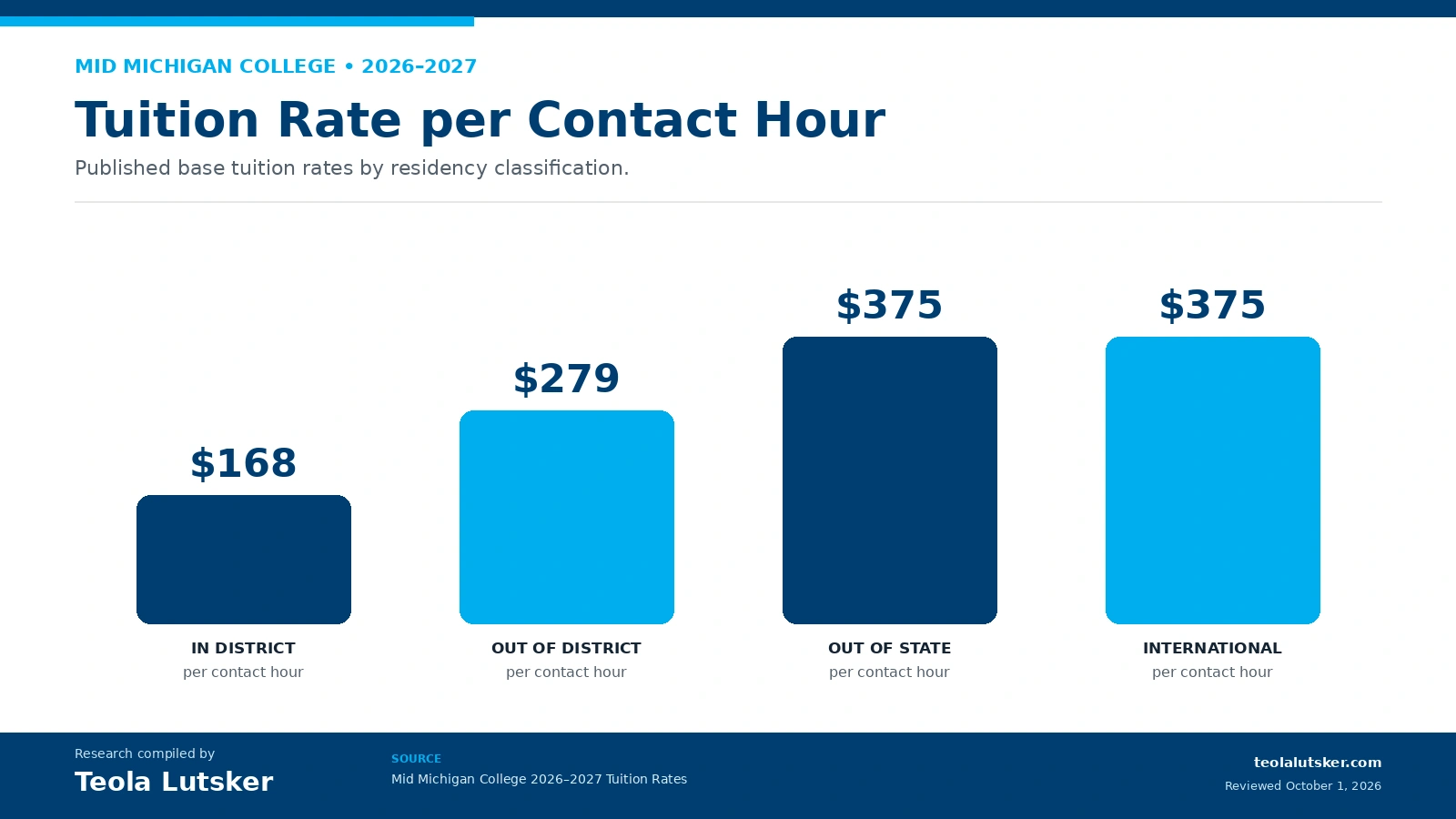
For 2026–2027, Mid Michigan College publishes base tuition of $168 per contact hour in district, $279 per contact hour out of district, and $375 per contact hour for out of state and international students. Additional technology, student activities, facilities, enrollment, course and program fees can apply.
Research note. Tuition, fees and financial aid programs can change. Figures below identify the applicable academic year where possible. Individual students should confirm their residency classification, charges and financial aid eligibility directly with Mid Michigan College and the appropriate state or federal program.
Mid Michigan College publishes base tuition of $168 per contact hour for in district students, $279 for out of district students, and $375 for out of state and international students. The College states that tuition is assessed per contact hour and is subject to change by action of the Board of Trustees.
Residency
Base tuition
In District
$168/contact hour
Out of District
$279/contact hour
Out of State
$375/contact hour
International
$375/contact hour
Published base tuition rates for 2026–2027. Research compiled by Teola Lutsker from Mid Michigan College records.
The difference between the published in district and out of district rates is $111 per contact hour. The difference between in district and out of state or international tuition is $207 per contact hour.
Mid Michigan College in district vs. out of district tuition
Mid identifies the public school districts of Beaverton, Clare, Farwell, Gladwin, Harrison and Mt. Pleasant as its in district area. The College explains that residents of the district provide local property tax support and receive the lower in district tuition rate, subject to its residency rules.
Beaverton Public Schools
Clare Public Schools
Farwell Area Schools
Gladwin Community Schools
Harrison Community Schools
Mt. Pleasant Public Schools
A mailing address or city name alone should not be used to determine tuition residency. Mid publishes specific residency criteria and may require documentation.
Why residency can change the final tuition amount
Residency is not a small adjustment at Mid. At the published 2026–2027 rates, an out of district student pays $111 more per contact hour in base tuition than an in district student. At 30 contact hours, that difference would be $3,330 before considering other charges. An out of state or international student pays $207 more per contact hour than the in district rate.
Mid's residency page notes that the six public school districts are the usual geographic basis for in district classification, while also recognizing other qualifying circumstances. Students who are uncertain about their classification should have Mid determine it before using an estimate on this page as a budget.
Who can qualify for in district status?
Mid's residency policy goes beyond simply asking which city appears in a mailing address. The College currently lists several paths to in district classification, including a dependent student whose parent or guardian maintains a primary residence in one of the six district school systems; a U.S. citizen or permanent resident who resides in the College district at registration; and certain students, spouses or parents of dependent students who own qualifying taxable real property in the district.
Mid also identifies certain employer paid students, qualifying military personnel, and students receiving benefits under the Children of Veterans Tuition Grant as possible in district classifications under its published criteria. The College may request a driver's license, voter registration card, state identification card, lease agreement or qualifying property tax receipt as documentation. A PO Box is not accepted as an in district address.
Residency has a deadline.
Mid says a residency change must be completed no later than the final tuition due date of the semester. After that deadline, the tuition rate charged stands for that semester, although a change can be requested for a future semester.
How does local property tax support connect to Mid?
District residency and local property tax support are related to the lower in district tuition rate. A separate research page examines Mid Michigan College's millage history, property tax revenue and 2026 proposal.
Does Mid Michigan College charge per credit hour or contact hour?
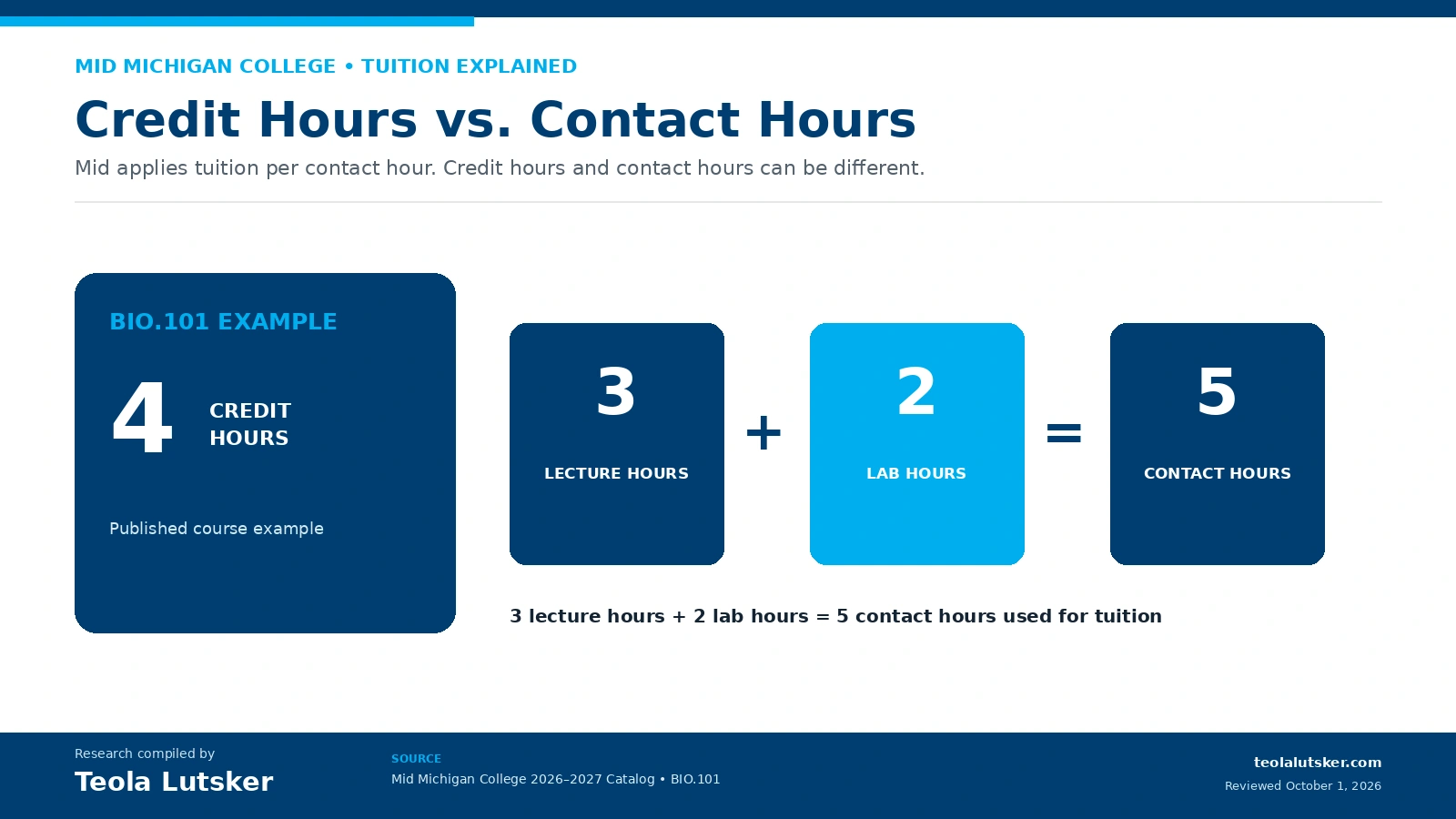
Mid charges tuition by contact hour, not simply by academic credit hour. The College's 2026–2027 catalog explains that contact hours are computed by totaling lecture and laboratory hours.
Mid uses BIO.101 as an example: the course carries 4 credits, but has 3 lecture hours and 2 laboratory hours, producing 5 contact hours for tuition purposes.
Mid's BIO.101 example illustrates why credit totals alone do not always determine tuition. Research compiled by Teola Lutsker.
A 60 credit degree does not necessarily mean 60 contact hours of tuition.
Laboratory, clinical, internship and other course formats can create different relationships between academic credits and contact hours.
How to estimate base tuition from contact hours
For a rough base tuition estimate, multiply the number of billable contact hours by the applicable residency rate. This calculation does not include technology, student activities, facilities, enrollment, course or program specific fees.
Example contact hours
In District
Out of District
Out of State / International
3 contact hours
$504
$837
$1,125
5 contact hours
$840
$1,395
$1,875
12 contact hours
$2,016
$3,348
$4,500
15 contact hours
$2,520
$4,185
$5,625
These are arithmetic examples using Mid's published 2026–2027 base tuition rates. They are not individual student bills and exclude additional fees.
What other fees does Mid charge?
Base tuition is not necessarily the complete student bill. Mid's 2026–2027 tuition information lists technology, student activities, facilities, enrollment and course fees.
Fee
Published charge
Technology
$20/contact hour
Student Activities
$9.50/contact hour
Facilities
$10/contact hour where applicable
Early Enrollment
$50
Late Enrollment
$100
Course Fees
Varies
Courses in Nursing, Radiography and Physical Therapist Assistant programs are assessed an additional $25 per contact hour above the base tuition rate.
Which fees apply to every student?
The fee categories do not all work the same way. Technology and student activities fees are published per contact hour for all students. The facilities fee applies where specified by Mid, including courses offered on the Harrison or Mt. Pleasant campuses and certain other course types. Course fees vary because some classes require specialized materials, equipment or other resources.
The enrollment fee is charged by semester rather than by contact hour. Mid publishes a $50 early enrollment fee and a $100 late enrollment fee, making registration timing another part of the final bill.
Mid Michigan College cost per semester
Mid's 2026–2027 Cost of Attendance table also publishes one semester estimates. For a 13 credit semester, the College lists tuition and fees of $3,068 in district, $4,589 out of district, and $5,772 out of state or international.
Residency
One semester tuition & fees
In District
$3,068
Out of District
$4,589
Out of State / International
$5,772
These are Mid's published tuition and fee estimates for a 13 credit semester. Individual charges can vary based on contact hours, course selection and applicable fees.
Mid Michigan College cost per year
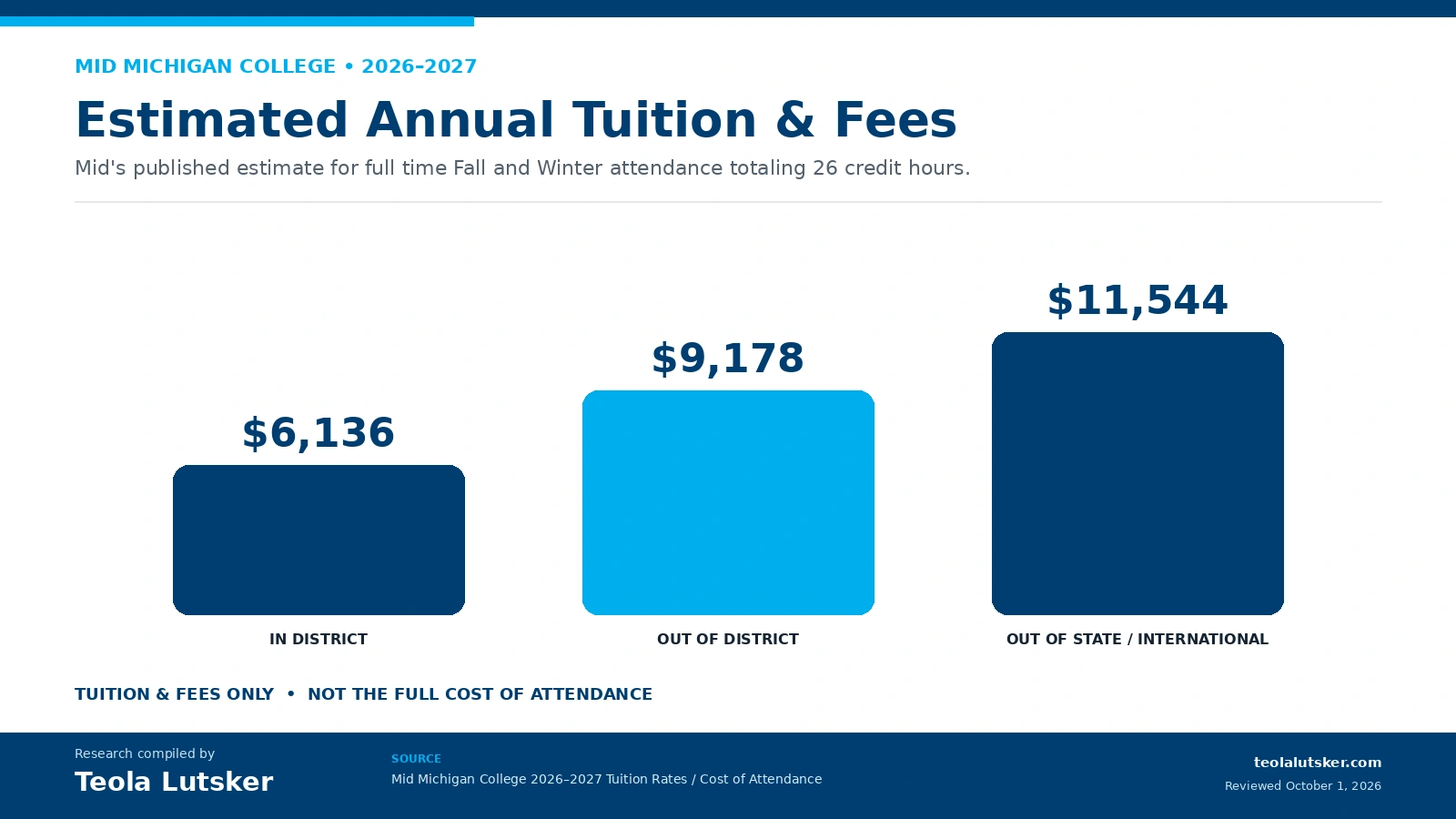
For financial aid purposes, Mid publishes a 2026–2027 Cost of Attendance based on full time attendance across Fall and Winter, totaling 26 credit hours for the academic year. Within that budget, Mid estimates tuition and fees of:
Residency
Estimated tuition & fees
In District
$6,136
Out of District
$9,178
Out of State / International
$11,544
Mid's published tuition and fee estimates for a 26 credit Fall and Winter academic year. These figures are not the same as total Cost of Attendance.
Tuition and Cost of Attendance are not the same thing
Cost of Attendance is a broader financial aid estimate. Mid explains that it can include tuition, books, housing, transportation and other personal expenses. It is used for financial aid purposes and should not be interpreted as the amount every student will be billed by the College.
Tuition and fees are only part of the financial aid budget.
Mid's Cost of Attendance can also include estimated educational and living expenses. Those estimates vary by a student's circumstances and are different from the tuition and fee figures shown above.
How to estimate what you may actually pay
Determine residency. Start with the in district, out of district, out of state or international classification.
Count contact hours. Do not assume course credits equal the contact hours Mid uses for tuition.
Add applicable fees. Technology, student activities, facilities, enrollment, course and program fees can change the bill.
Check program-specific costs. Clinical, laboratory and occupational programs can have tuition differentials, equipment and other expenses.
Apply grants and scholarships. FAFSA based aid, Pell, state programs and Mid scholarships can reduce eligible costs.
Separate the bill from Cost of Attendance. Mid uses a broader financial aid budget that can include estimated educational and living expenses that are not necessarily billed by the College.
This sequence explains why there is no single number that represents every student's final cost. The published tuition rate is the starting point, not necessarily the final amount due.
Mid Michigan College Net Price Calculator: an important data-year warning
Mid provides a federal Net Price Calculator, but its current calculator page says the estimates are based on 2021–2022 data and assume 26 credits over two semesters. That makes the calculator useful as a general planning tool, but its underlying price and aid data should not be mistaken for Mid's current 2026–2027 tuition rates or a current individual financial aid offer.
Current tuition and net price are different measures.
This page uses Mid's published 2026–2027 tuition and Cost of Attendance figures for current rates. Net price is a separate estimate that accounts for grant aid, and an individual's actual aid must be determined through the current FAFSA and Mid's Financial Aid process.
Mid Michigan College program costs: why the degree matters
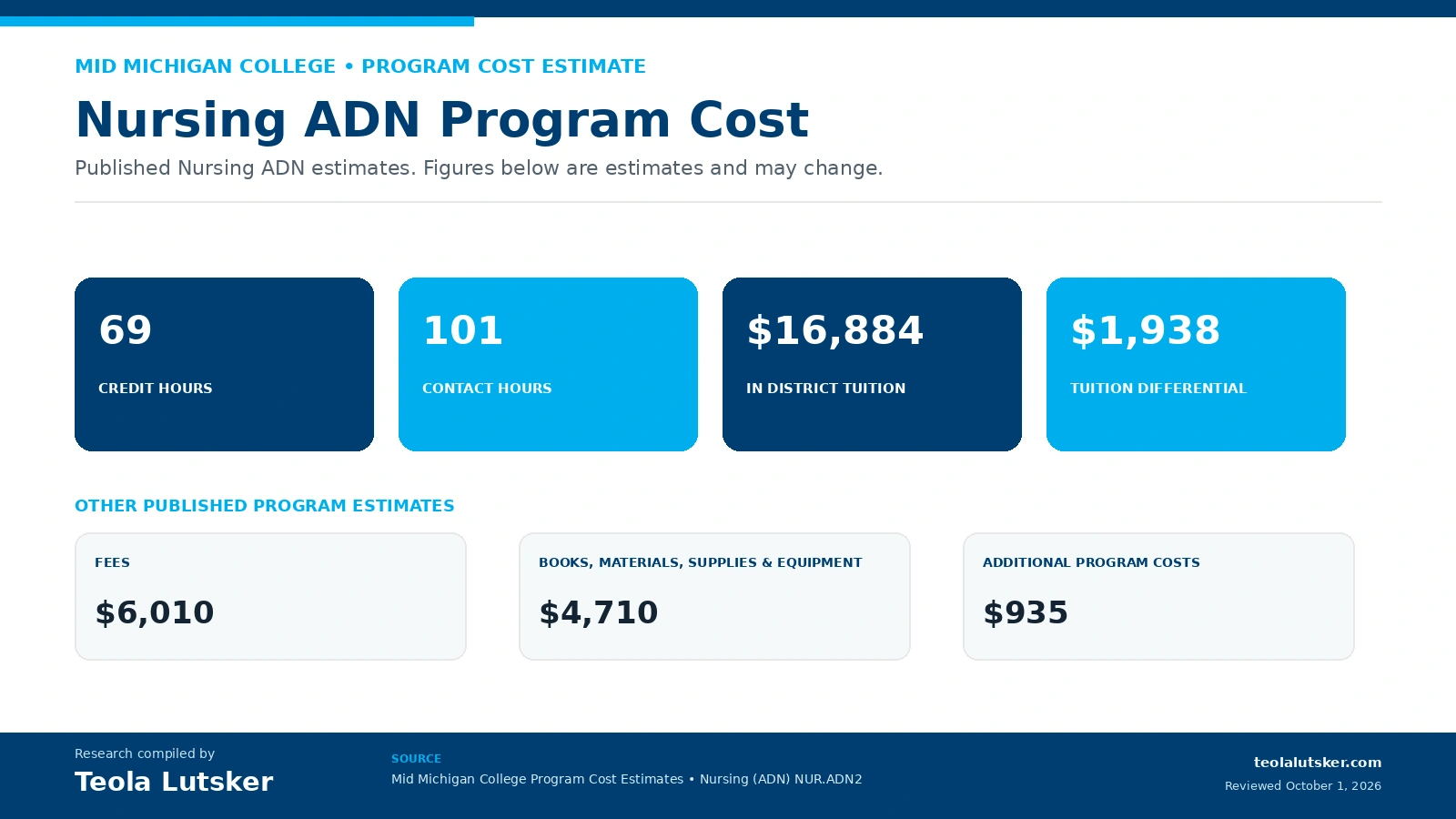
A single College wide tuition rate does not mean every program has the same total cost. Mid's Program Cost Estimator combines credit hours, contact hours, tuition, tuition differentials, program fees, books and supplies, and certain additional program expenses for selected programs. Mid describes these figures as estimates that can change.
These examples show why two programs with nearly identical credit totals can still have different tuition. Physical Therapist Assistant and Radiography both list 68 credits, for example, but the estimator lists 113 contact hours for PTA and 98 for Radiography.
Nursing is one example of how program credits, contact hours and tuition estimates can diverge. Research compiled by Teola Lutsker.
What else can appear in a program estimate?
Mid's estimator separately identifies books, course materials, supplies and equipment, as well as additional program costs such as exams, licensure or apparel where applicable. For Nursing, the estimator currently lists $4,710 for books, course materials, supplies and equipment and $935 in additional program costs. PTA lists $3,140 and $1,170 in those categories, while Radiography lists $3,140 and $395.
Program cost is more than tuition.
For programs with labs, clinical requirements, equipment, licensing or specialized materials, the difference between the base tuition calculation and the broader program estimate can be substantial. Mid's estimator should be checked for the specific program and residency category.
From price to aid: Once tuition, fees and program costs are estimated, the next question is which resources can reduce the amount a student must cover.
Mid Michigan College financial aid, FAFSA and school code
For the 2026–2027 academic year, Mid directs students to complete the FAFSA using 2024 tax information. The 2026–2027 FAFSA covers Fall 2026, Winter 2027 and Summer 2027.
Mid Michigan College FAFSA school code: 006768
Mid identifies FAFSA as the starting point for federal aid and many state and College based financial aid options. A student's actual aid offer depends on individual eligibility and enrollment circumstances.
Mid's financial aid materials identify grants, scholarships, work study and student loans among the potential forms of assistance. Students using state tuition programs such as Michigan Reconnect or the Community College Guarantee also need to follow applicable FAFSA requirements.
FAFSA Submission Summary, Student Aid Index and the aid offer
The 2026–2027 FAFSA uses the Student Aid Index (SAI). Federal Student Aid explains that the SAI is an index calculated from FAFSA information. It is not the amount a family is expected to pay and it is not the student's final financial aid offer.
After the FAFSA is processed, the FAFSA Submission Summary can show the student's SAI and estimated federal aid eligibility. The actual financial aid offer comes from the College after admission and review of the student's eligibility.
FAFSA → SAI → College aid offer
The FAFSA supplies financial information. The federal system calculates the Student Aid Index. Mid then uses the applicable federal, state and institutional rules to determine the student's aid offer.
What if Mid asks for FAFSA verification?
Submitting the FAFSA does not always finish the process. Mid says students selected for verification must provide the requested documentation before financial aid can be finalized. Students should monitor their Mid Mich email and Self-Service financial aid requirements after filing.
What if the FAFSA no longer reflects a family's finances?
Mid also publishes a Special Circumstance Review process. If income or financial circumstances have changed significantly since the information reported on the FAFSA, Financial Aid may review documented circumstances and, when federal rules allow, adjust FAFSA information. Mid notes that a review does not guarantee additional or different aid.
Federal Pell Grants and Mid Michigan College
Federal Pell Grants are need based grants for eligible undergraduate students and generally do not have to be repaid. For the 2026–2027 award year, the federal maximum Pell Grant is $7,395. A student's actual eligibility can be lower and depends on federal rules and FAFSA information.
Pell is especially relevant to this page because it can interact with Michigan's tuition assistance programs. Michigan Reconnect is a last dollar scholarship, so applicable Pell funds are applied before Reconnect pays eligible remaining tuition and mandatory charges. Pell eligibility can also trigger the additional $1,000 Michigan Achievement Bonus under the Community College Guarantee.
Is Mid Michigan College tuition free?
For some eligible students, state financial aid can cover in district tuition and certain mandatory costs. But tuition free does not necessarily mean every expense associated with attending college is free.
Coverage depends on the program and individual eligibility. Students should verify current rules with the State of Michigan and Mid.
Michigan Reconnect at Mid Michigan College
Michigan Reconnect is a state last dollar scholarship for qualifying adult learners. In August 2026, eligibility was expanded so Michigan residents age 21 and older can apply. Current state guidance also requires applicants to meet Michigan residency and education requirements and not already hold an associate or bachelor's degree.
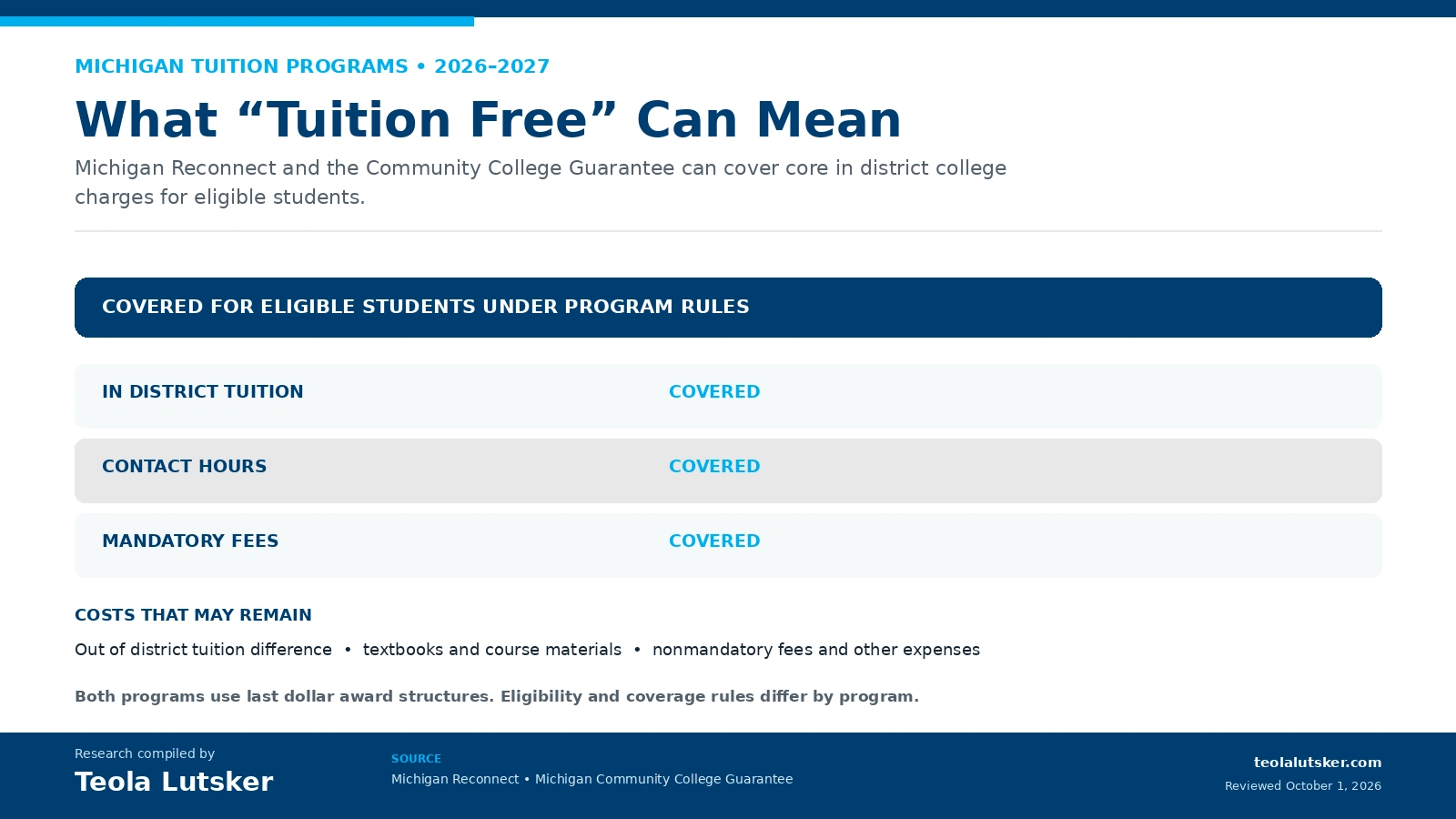
Reconnect is a last dollar scholarship. Applicable federal and state tuition restricted aid is applied first, and Reconnect then covers eligible remaining in district tuition, mandatory fees and contact hour charges. The State explains that students can remain responsible for costs such as an out of district tuition difference, books and course materials, and certain nonmandatory fees.
What Reconnect covers
Eligible in district tuition
Mandatory fees charged to all students per semester or per hour
Eligible contact hour charges
What Reconnect does not automatically cover
The out of district tuition difference
Fees charged only to certain students, such as some course or lab fees
Books and other expenses that are not eligible tuition or mandatory fees
The State says Reconnect can be combined with other financial aid. Federal aid such as Pell is applied first, followed by applicable grants or scholarships, with Reconnect covering remaining eligible charges. Current state guidance allows eligible students to keep using Reconnect until they earn an associate degree or reach four years from their first Reconnect semester, as long as program requirements continue to be met.
Community College Guarantee at Mid Michigan College
Michigan's Community College Guarantee provides eligible recent Michigan high school graduates with support for in district tuition, contact hours and mandatory fees at an eligible community college or Tribal college. Students attending out of district can remain responsible for costs above the in district amount.
For the 2026–2027 program year, current state guidance requires a current FAFSA, Michigan residency, qualifying high school completion, undergraduate status, full time enrollment, enrollment within the applicable 15 month window, and satisfactory academic progress, among other requirements. The State says the Community College pathway does not require students to meet a Student Aid Index threshold.
What the Community College Guarantee can provide
Up to in district tuition, contact hours and mandatory fees at an eligible Michigan community college or Tribal college.
Up to three years of Community College Guarantee eligibility when renewal requirements are met.
An additional $1,000 Michigan Achievement Bonus for Pell eligible students that can help with other college costs.
For out of district students, the state award cannot exceed the applicable in district tuition, contact hours and mandatory fees. That means residency can still affect the amount left for the student to pay.
Eligibility, enrollment, FAFSA and renewal requirements can change by graduating class and academic year, so students should use current MI Student Aid guidance rather than relying on an older summary.
Why FAFSA still matters
State tuition assistance programs can still require the FAFSA because eligibility and the amount of other applicable financial aid must be established. A tuition assistance program does not eliminate the financial aid process.
Receiving aid is only the first step: Federal and state assistance also carries continuing enrollment and academic requirements.
Receiving financial aid is not only about qualifying initially. Mid requires students receiving federal and state aid to meet its Satisfactory Academic Progress standards. Mid reviews academic records for SAP at the end of each semester of enrollment.
SAP measure
Mid's published standard
Overall GPA
Minimum 2.0
Completion rate
Complete at least 67% of attempted credits
Maximum time frame
Aid eligibility generally limited to 150% of credits required for the program
Mid states that F, W and I grades count as attempted but not completed credits for the completion calculation. Students who fail SAP can move through warning or ineligible statuses depending on the circumstances, and Mid provides an appeal process for students who become ineligible.
Can financial aid be used for summer classes?
Mid says summer aid can be available, but the FAFSA year and eligibility depend on the semester. Summer 2027 uses the 2026–2027 FAFSA. Mid also notes that students who attended full time in Fall and Winter may be eligible for a summer Pell Grant, while Federal Direct Loan eligibility can depend on remaining annual loan eligibility and enrollment of at least six credits.
Federal student loans at Mid Michigan College
Loans are different from grants and scholarships because borrowed funds must generally be repaid with interest. Mid's current 2026–2027 loan guidance says students must complete the FAFSA and be enrolled at least half time to be considered for Federal Direct Loans.
Undergraduate level
Dependent annual limit
Independent annual limit
First year, 0–24 earned credits
$5,500
$9,500
Second year, 25+ earned credits
$6,500
$10,500
A major 2026–2027 change for part time borrowers
Mid says federal loan rules change for enrollment periods beginning on or after July 1, 2026. Students enrolled less than full time can have their federal loan eligibility prorated according to enrollment. Mid's examples show how this can reduce the amount available to help with tuition and living expenses.
Mid currently lists a 6.52% fixed interest rate for subsidized and unsubsidized loans first disbursed between July 1, 2026 and June 30, 2027, along with a 1.057% origination fee. Because federal rates and fees are time sensitive, borrowers should confirm them before accepting a loan.
Mid says loans are generally posted to student accounts approximately six to eight weeks after the semester begins after eligibility and participation requirements are satisfied. Students must generally remain enrolled in at least six credits at disbursement.
Other ways Mid students may receive help with college costs
Federal Work Study
Mid's work study program provides jobs for eligible students with financial need. Students must file the FAFSA, have unmet need, complete a work study application, meet SAP and be enrolled at least part time. Work-study earnings are paid biweekly and, unlike a grant applied to the account, Mid says those earnings cannot be used to charge tuition, fees or books directly.
Student Emergency Assistance Fund
The Mid Michigan College Foundation's Student Emergency Assistance Fund can provide one time help for qualifying currently enrolled degree-seeking students facing an unexpected financial emergency that could otherwise prevent them from continuing. Mid says this fund is not intended for routine tuition, textbooks, past due balances or monthly bills and is not a replacement for financial aid.
Vocational Educational Assistance Program
Mid's Carl Perkins Vocational Educational Assistance Program, or VEAP, serves qualifying students in approved occupational programs. Depending on eligibility and unmet need, assistance can include tuition and fees, books and supplies, transportation and child care. Mid lists qualifying populations that include single parents, displaced homemakers, nontraditional job trainees, individuals with disabilities, economically disadvantaged students and students with limited English proficiency.
Credit for Prior Learning
Reducing the number of courses a student needs to complete can also affect total educational cost. Mid offers evaluation of certain prior learning and skills gained through work and life experience. If nontraditional credit is approved, Mid currently charges $20 per credit to place that credit on the student's transcript. Mid notes that this credit is not designed to transfer to other colleges or universities.
Veteran education benefits
Mid is approved for multiple veteran education benefit programs and encourages veterans to complete the FAFSA because additional aid may be available alongside eligible VA benefits. Mid also maintains veteran-specific scholarship support for some students whose benefit funding is delayed or whose circumstances are not fully addressed by federal and state aid programs.
Mid Michigan College scholarships and financial assistance
Mid also administers institutional and donor supported scholarships. For 2026–2027, Mid says one general scholarship application places a student into consideration for available Mid Scholarships. The published application window is October 15 through May 15, with priority given to applications received by March 15.
One example is Mid's Admissions Award, listed at $1,000, divided between Fall and Winter for qualifying full time students from local high schools with a GPA above 3.0. Scholarship availability and eligibility can change, so students should review Mid's current scholarship listing.
Enrollment changes can change cost: Dropping or withdrawing can affect tuition, enrollment status and financial aid under different rules.
What happens to financial aid if a student withdraws?
A tuition refund deadline and federal financial aid rules are not the same thing. Mid's Return of Title IV Funds policy says a student who withdraws from all classes before completing more than 60% of the semester can have federal aid eligibility recalculated according to the portion of the semester completed.
For example, Mid explains that a student who completes 30% of the semester has generally earned 30% of the applicable Title IV aid for purposes of the federal return calculation. The unearned portion may need to be returned by the College and, in some situations, by the student. After the 60% point, Title IV aid is generally treated as 100% earned for this calculation.
Dropping one class, withdrawing from all classes and receiving a tuition refund are different issues.
A schedule change can affect tuition charges, enrollment level, SAP and financial aid in different ways. Mid strongly encourages students considering a complete withdrawal before the 60% point to contact Financial Aid first.
Dual enrollment and special tuition classifications
Mid's 2026–2027 tuition table places dual enrollees at the $168 in district base tuition rate. The College catalog also describes specific in state tuition treatment for qualifying students using certain U.S. Department of Veterans Affairs educational benefits. These classifications have their own eligibility rules and should be confirmed with Mid.
Why can Mid Michigan College cost numbers look different?
A search can produce numbers representing completely different measures: base tuition per contact hour, annual tuition and fees, Cost of Attendance, program cost, net price after grant aid, or historical figures from a previous academic year.
Before comparing two Mid cost figures, ask two questions:
What does this number measure? What academic year does it represent?
For this research page, current College cost figures are taken primarily from Mid Michigan College's published 2026–2027 information. State program information is sourced to current State of Michigan resources.
How the Board of Trustees fits into tuition
Mid states that tuition rates are subject to change through action of the Board of Trustees. That makes tuition an institutional governance issue as well as a student cost issue. This page does not attempt to predict future tuition decisions; it documents the currently published 2026–2027 figures.
Research by Teola Lutsker
Teola Lutsker
I started looking more closely at the cost of attending Mid Michigan College because the answer is more complicated than a single tuition number. Residency changes the tuition rate. Credit hours and contact hours are not always the same. Programs with similar credit requirements can have very different numbers of contact hours, while financial aid and Cost of Attendance measure still other parts of the picture.
I compiled this resource to bring those pieces together in one place and make it easier for students, families and community members to understand the numbers and trace them back to their original sources.
Mid Michigan College cost and financial aid glossary
Term
What it means on this page
Credit hour
Academic credit assigned to a course. It is not always the same as the contact hours used to calculate Mid tuition.
Contact hour
The instructional contact measure Mid uses for tuition. Lecture, lab and other course formats can affect the total.
Tuition
The base instructional charge calculated using the applicable residency rate and contact hours.
Mandatory fee
A fee required broadly for enrollment or attendance. State tuition programs define covered mandatory fees under their own rules.
Cost of Attendance
A financial aid budget that can include direct College charges plus estimated books, housing, food, transportation and personal expenses.
Net price
The amount remaining after applicable grants and scholarships are subtracted from the broader cost measure used for the calculation.
FAFSA
The Free Application for Federal Student Aid, used for federal aid and by many state and College aid programs.
Student Aid Index
An index calculated from FAFSA information and used in financial aid eligibility. It is not a bill or the amount a family is expected to pay.
Last dollar scholarship
A program that applies after specified other aid and pays remaining eligible charges under the program's rules.
Satisfactory Academic Progress
Academic standards students must continue to meet to remain eligible for federal and state financial aid at Mid.
Frequently asked questions
Why did Mid ask me for FAFSA verification documents?
Some FAFSA records are selected for verification. Mid says requested documents must be provided before financial aid can be finalized.
Can Mid review my financial aid if my family's income changed?
Potentially. Mid offers a Special Circumstance Review for certain significant financial changes when federal rules allow an adjustment. A review does not guarantee additional aid.
What happens to federal aid if I withdraw from all my Mid classes?
Before the 60% point of a semester, Mid may have to recalculate how much Title IV federal aid was earned based on the portion of the semester completed. This can create an amount that must be returned.
Can I use work study to pay my Mid tuition bill?
Mid says work study earnings are paid biweekly and cannot be used to charge tuition, fees or books directly.
Does Mid offer emergency financial help?
Mid's Foundation maintains a Student Emergency Assistance Fund for qualifying enrolled students facing documented unexpected emergencies. It is not intended for routine tuition, textbooks, past due balances or ordinary monthly bills.
Can prior work or life experience reduce the credits I need at Mid?
Mid offers evaluation of certain prior learning and skills. If approved, nontraditional credit currently costs $20 per credit to place on the Mid transcript and is not designed to transfer to another institution.
Does Mid Michigan College accept Pell Grants?
Yes. Eligible Mid students can receive Federal Pell Grants. For 2026–2027, the federal maximum Pell Grant is $7,395, although individual awards vary.
What GPA do I need to keep financial aid at Mid?
Mid's Satisfactory Academic Progress policy requires a minimum overall 2.0 GPA, along with a 67% completion rate and compliance with the maximum time frame requirement.
Does Michigan Reconnect pay for books at Mid?
Reconnect covers eligible in district tuition, mandatory fees and contact hour charges after applicable aid. Books and course materials are not automatically covered by Reconnect.
Does the Community College Guarantee pay for books?
The core Community College Guarantee covers eligible in district tuition, contact hours and mandatory fees. Pell eligible students may receive the additional $1,000 Michigan Achievement Bonus, which can be used toward additional college costs.
What is Mid Michigan College's FAFSA school code?
Mid Michigan College's federal school code is 006768.
How much is one semester at Mid Michigan College?
For 2026–2027, Mid's published 13 credit semester estimate lists tuition and fees of $3,068 in district, $4,589 out of district, and $5,772 out of state or international. Cost of Attendance is higher because it includes estimated living and educational expenses.
What fees does Mid Michigan College charge?
Mid lists a $20 per contact hour technology fee, $9.50 per contact hour student activities fee, a $10 per contact hour facilities fee where applicable, enrollment fees, and course fees that vary. Certain health programs also carry a tuition differential.
Does Mid Michigan College offer scholarships?
Yes. Mid administers College and donor supported scholarships and says one general application places students into consideration for available Mid Scholarships. Eligibility varies by award.
How do I estimate Mid Michigan College tuition?
Start with the number of contact hours rather than assuming credit hours are the same. Multiply contact hours by the applicable residency rate, then account for technology, student activities, facilities, enrollment, course and program specific fees where applicable.
How much is Mid Michigan College tuition in 2026–2027?
Mid publishes base tuition of $168 per contact hour for in district students, $279 for out of district students, and $375 for out of state and international students for 2026–2027. Additional fees and some program charges may apply.
Does Mid Michigan College charge by credit hour or contact hour?
Mid charges tuition by contact hour. Contact hours are computed from lecture and lab hours, so a course can have more contact hours than academic credit hours.
What school districts are in Mid Michigan College's district?
Mid identifies Beaverton, Clare, Farwell, Gladwin, Harrison and Mt. Pleasant public school districts as its in district area, subject to the College's individual residency rules.
How much does Mid Michigan College estimate tuition and fees for one academic year?
For 2026–2027, Mid estimates $6,136 in district, $9,178 out of district, and $11,544 out of state or international for 26 credit hours across Fall and Winter.
Is Mid Michigan College tuition free?
Eligible students may have in district tuition and certain mandatory costs covered through programs such as Michigan Reconnect or the Community College Guarantee. Tuition free does not necessarily mean all books, housing, food, transportation or other college expenses are covered.
Does Michigan Reconnect cover out of district tuition?
Michigan Reconnect is designed around in district tuition. Eligible students attending an out of district community college can remain responsible for the difference above the in district amount.
Why do different websites show different Mid Michigan College cost numbers?
Different sources may be showing base tuition, tuition and fees, Cost of Attendance, net price, program cost, or figures from different academic years. Those measures are not interchangeable.
What is the difference between tuition and Cost of Attendance?
Tuition and fees are enrollment related charges. Cost of Attendance is a broader financial aid estimate that can also include books, food, housing, transportation, personal expenses and loan fees.
Sources & original records
The figures in this guide are drawn primarily from first party College records and official state or federal program information. Links below lead to the underlying resources so readers can verify current information directly.
Source methodology: Current College charges and Cost of Attendance figures are taken from Mid Michigan College’s 2026–2027 published materials. State scholarship information is sourced to official Michigan program pages. Figures should be rechecked when Mid publishes a new academic year.